
















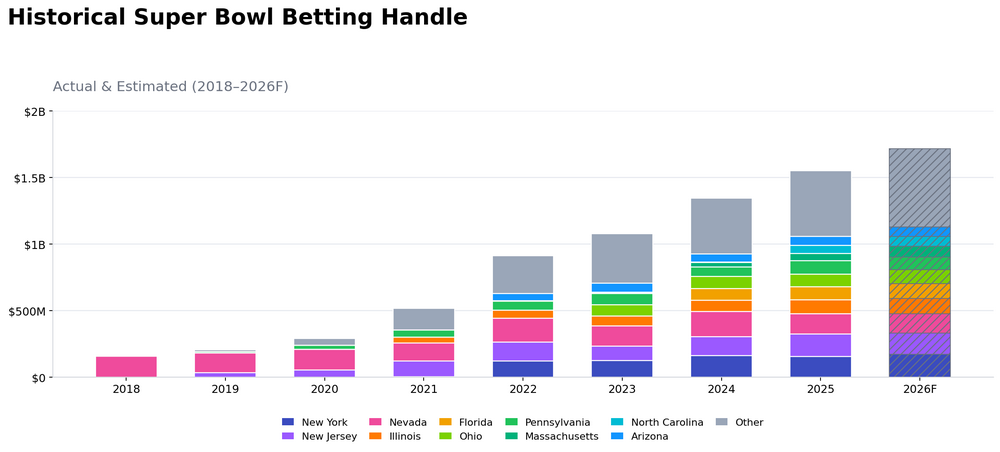
Legal sports betting in the United States is projected to reach $1.71 billion in wagers for Super Bowl LX, extending what analysts describe as an eight-year run of record-setting handle for the NFL’s biggest weekend. The forecast, published January 27, 2026 by Legal Sports Report, frames the headline number as “approaching $1.75 billion” while warning that the industry’s growth profile is changing fast.
Super Bowl LX will be played on February 8, 2026 at Levi’s Stadium in Santa Clara, California, a high-visibility stage that sportsbooks increasingly treat as a customer acquisition and retention event—not just a single-day spike. Legal Sports Report notes the game typically represents about 1% of annual U.S. betting volume, roughly equivalent to three average days of nationwide traffic, which helps explain why operators are willing to spend heavily on promotions and product innovation around the Super Bowl.

The state-by-state breakdown highlights where liquidity concentrates. Based on the publication’s compiled reporting for recent Super Bowls, the biggest 2025 handles came from New York ($170.7m), New Jersey ($160.6m), Nevada ($151.6m), Illinois ($113.5m), Florida ($112.0m), Ohio ($104.5m) and Pennsylvania ($96.9m), with additional large markets including Massachusetts ($78.7m) and North Carolina ($76.6m).
What’s new in 2026 is the competitive backdrop. The forecast argues the sector is moving from rapid expansion into incremental growth, as most eligible bettors already have access to regulated sportsbooks. At the same time, the “betting-like” universe is widening: prediction markets, fantasy-style prop contests, and other adjacent products can pull attention and wallet share away from traditional sportsbooks—creating a more fragmented environment even as total demand remains strong.

The report also contextualizes the growth curve: early post-PASPA Super Bowl reporting covered just eight states and roughly $200 million in 2019, then crossed $500 million by 2021 and surpassed $1 billion by 2023. Estimates for last year’s Super Bowl were cited as “up to” $1.5 billion across 40 states and territories, though uneven disclosure still leaves gaps in the true national total.