
















Ontario’s regulated iGaming market posted CAD 7.1 billion in wagers and CAD 280 million in gaming revenue in February 2026, according to the latest monthly data released by iGaming Ontario on March 25. The numbers were lower than the all-time highs reported in January, but they still point to a market that remains large, active and commercially resilient rather than one losing momentum.

The more accurate reading is not “slowdown” in the negative sense, but normalization after a record month. January had set a new benchmark with roughly CAD 9.5 billion in handle and CAD 402 million in revenue, making February’s pullback look more like a reset from an exceptional peak than a sign of structural weakness. In mature regulated markets, those month-to-month swings often say as much about seasonal betting patterns and hold dynamics as they do about consumer demand.

What is harder to dispute is Ontario’s scale. In its 2024-25 annual report, iGaming Ontario confirmed that the province generated CAD 82.7 billion in wagers and CAD 2.9 billion in total gaming revenue, up more than 30% year-on-year, with 50 active operators and more than 2.6 million active player accounts over the fiscal year. That means Ontario has already crossed the threshold that older market commentary was still treating as a projection.
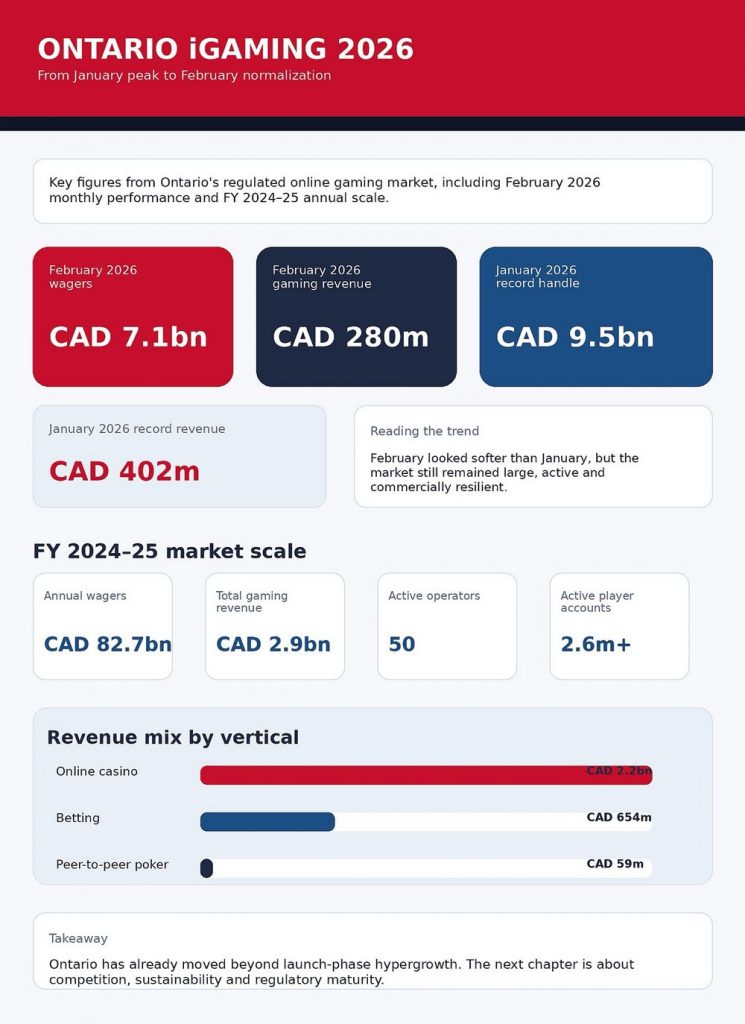
The annual data also shows what continues to drive the business. Online casino produced CAD 2.2 billion in revenue, far ahead of CAD 654 million from betting and CAD 59 million from peer-to-peer poker, confirming that casino remains the commercial engine of Ontario’s regulated model. Betting may dominate headlines, but casino still pays the bills.
Another important shift is institutional. iGaming Ontario’s annual report confirms that the organization became an independent agency separate from the AGCO in 2024-25, with an added mandate to promote economic development and revenue generation for the province. That makes Ontario’s next chapter less about explosive launch-era growth and more about competition, sustainability and regulatory maturity.
Ontario is still growing. But it is now growing as a market that has already proven itself. And that changes the story.