















U.S. sports-betting operators entered Super Bowl week with a familiar tailwind—record attention and rising legal participation—but a new narrative has started to weigh on listed gaming names: prediction markets siphoning high-intent volume away from state-licensed books.
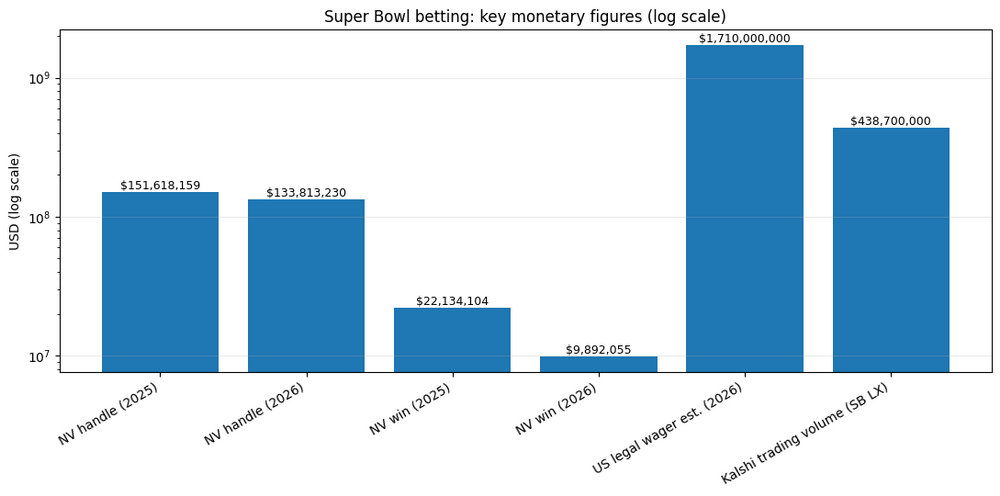
From an operator-financial lens, the headline is not “demand is weak.” The American Gaming Association projected US$1.76 billion in legal Super Bowl wagering, a figure that would mark a new high for regulated sportsbooks. The market concern is where incremental activity is showing up—and whether it shows up in the metrics investors model most closely: handle, net gaming revenue, customer acquisition cost, and hold.

Prediction markets complicate that model because they often report trading volume, not sportsbook handle. Trading volume can balloon as contracts change hands multiple times before kickoff, which means large numbers do not translate 1:1 into operator revenue. Still, the scale is hard for equity analysts to ignore: estimates around Super Bowl winner contracts suggested roughly US$1.5 billion in trading volume across major venues, including Polymarket (~US$700 million) and Kalshi (~US$500 million), plus additional activity via a Robinhood offering.
CFTC shift on “event contracts” fuels prediction-market boom ahead of Super Bowl in California

For public operators such as DraftKings and Flutter Entertainment (FanDuel), the risk is twofold. First, even modest “leakage” can pressure near-term growth expectations, especially when investor sentiment is anchored to marquee-event conversion. Second, the regulatory perimeter is still being drawn. Prediction markets sit closer to federal commodities oversight than to the state-by-state sportsbook framework, creating a perceived asymmetry in distribution, product scope, and speed to market.
Regulatory uncertainty cuts both ways. The CFTC’s evolving stance on event contracts is a swing factor, while state-level scrutiny—Massachusetts has been a notable flashpoint—adds volatility for both prediction platforms and traditional books. Operational frictions also surfaced, including reports of transfer delays during peak demand, highlighting infrastructure stress tests that come with rapid scaling.