














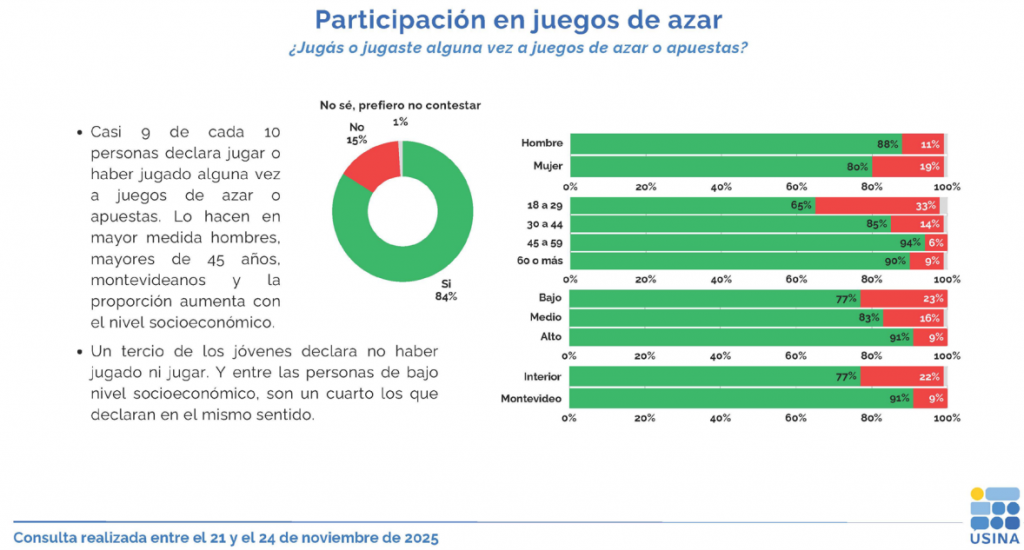
Uruguay confirmed in April 2026 the structural weight of gambling in its economy: an official survey by the Dirección Nacional de Loterías y Quinielas (DNLQ), released on April 10, shows that nearly 9 out of 10 Uruguayans have participated in betting, within a market that now exceeds US$700 million annually.

The study, conducted between November 21–24, 2025 on a sample of 500 adults, reports participation rates of 84% among men and 72% among women, with higher concentration among people over 45 and residents of Montevideo. Physical channels dominate with 61% usage, compared to 12% online, while weekly spending is mostly below UYU 500. The survey also highlights social concerns: 87% link gambling to financial problems and 75% associate it with addiction, elevating the issue to a public policy priority.
Market growth aligns with these figures. Uruguay’s gambling sector—driven by lotteries, quinielas, and state-run casinos—has surpassed US$700 million in total volume, supported by high participation rates and nationwide reach. While online gambling remains a smaller segment, it is the fastest-growing and the main regulatory focus.
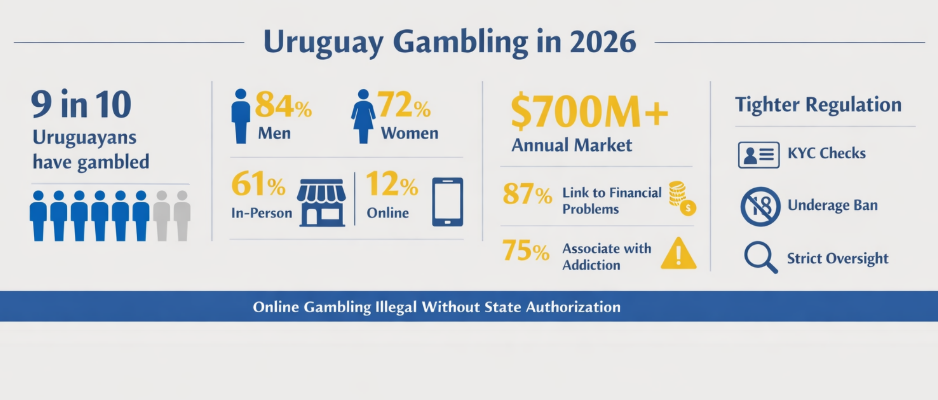
In response, the Ministerio de Economía y Finanzas (MEF), led by Gabriel Oddone, strengthened oversight in January 2026 with the enforcement of Resolution No. 015/2026, introducing mandatory KYC identity verification, strict age controls, and enhanced transaction monitoring for authorized platforms. Additional compliance measures implemented during the first quarter further tightened authentication and responsible gambling requirements.
The legal framework remains unchanged: online gambling is still illegal without state authorization, under Law No. 1.595 (1882), Law No. 19.535 (2017), and Decree 366/017, enabling authorities to block websites, restrict payments, and sanction unauthorized operators.
The signal is clear: as demand surges, regulation intensifies. Uruguay is not liberalizing gambling in 2026—it is tightening control over a rapidly expanding market.