

















Vietnam consolidated one of Asia’s fastest-growing state-run lottery markets in 2025, with revenue reaching VND177.2 trillion (US$6.8 billion), up 10.5% year-on-year, while the sector maintained average annual growth of 10.2%, according to data released by the Ministry of Finance on September 24, 2026.

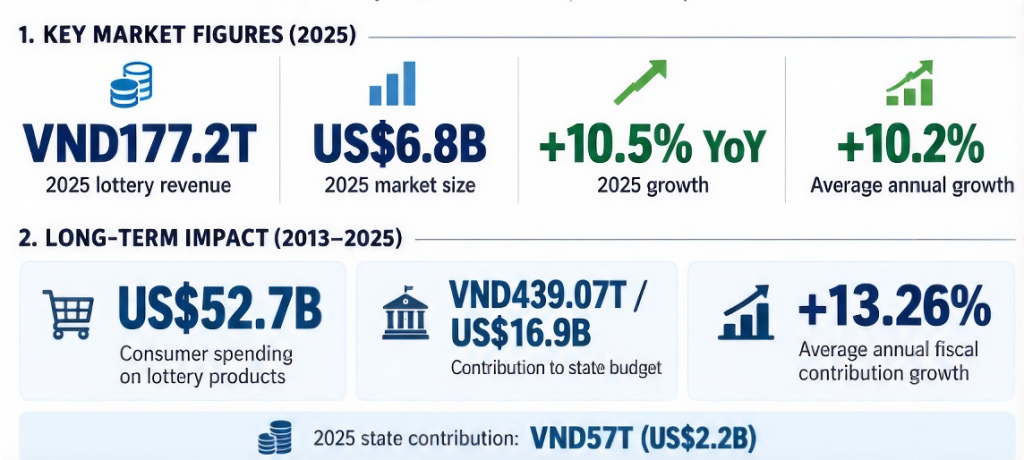
Between 2013 and 2025, consumers spent more than US$52.7 billion on lottery products, while the sector contributed VND439.07 trillion, around US$16.9 billion, to the state budget. Fiscal contributions grew at an average annual rate of 13.26%. In 2025 alone, lottery payments to the state exceeded VND57 trillion (US$2.2 billion).
The market is overseen by the Ministry of Finance, headed by Minister Ngô Văn Tuấn, who was appointed on April 8, 2026 for the 2026–2031 term. Within the ministry, state management of lotteries, betting, casinos and prize-based gaming falls under the Department of Financial Institutions, led by Director Vũ Đức Hội.
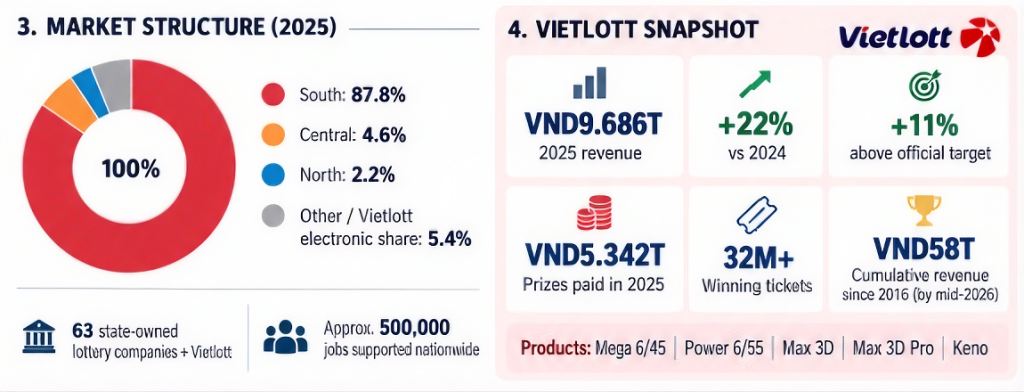
Vietnam’s system comprises 63 state-owned lottery companies controlled by provincial and centrally governed city People’s Committees, alongside the national electronic lottery operator Vietnam Lottery Company — Vietlott, which is owned by the Ministry of Finance.

General Director Phạm Ngọc Tú
Vietlott is currently led by General Director Phạm Ngọc Tú. Its official website also identifies Phạm Quang Huy as Deputy General Director and the corporate representative responsible for the portal. Southern Vietnam dominates the traditional lottery business with 87.8% of revenue, compared with 4.6% in the central region and 2.2% in the north. The distribution network supports around 500,000 jobs nationwide.


Vietlott generated VND9.686 trillion in 2025, up 22% from 2024 and 11% above its official target. It paid more than VND5.342 trillion in prizes, covering over 32 million winning tickets, while products include Mega 6/45, Power 6/55, Max 3D, Max 3D Pro and Keno. Since commercial operations began in 2016, Vietlott had accumulated nearly VND58 trillion in revenue by mid-2026. Lottery-related state revenue continued growing in 2026, rising 6.3% year-on-year in the first quarter and reaching 39.3% of the annual target.