

















Kentucky reshaped its gaming framework on April 14, 2026, after lawmakers overrode Governor Andy Beshear’s veto of House Bill 904, passing it with decisive margins of 67–7 in the House and 26–5 in the Senate. The bill, led by Representative Michael Meredith, expands wagering products while strengthening regulatory oversight in one of the fastest-growing U.S. betting markets.

The reform builds on the 2023 legalization of sports betting (HB 551), regulated by the Kentucky Horse Racing and Gaming Corporation (KHRG), headed by CEO Jamie Eads and Chairman Jonathan Rabinowitz. HB 904 introduces structural changes aimed at balancing expansion with tighter control.

Key provisions include raising the legal betting age from 18 to 21, banning the use of credit cards for gambling deposits, and authorizing fixed-odds wagering on live horse racing, a major shift in a state where horse racing remains a core economic pillar. The law applies existing tax rates to this new vertical: 9.75% on retail wagering revenue and 14.25% on online wagering revenue.
The legislation also formalizes fantasy contests, introducing licensing requirements and a 12% tax on adjusted revenues, while placing new restrictions on relationships with prediction markets, signaling regulatory caution toward emerging digital betting models. Oversight is shared between KHRG and the Kentucky Department of Revenue, reinforcing enforcement across both operational and fiscal layers.
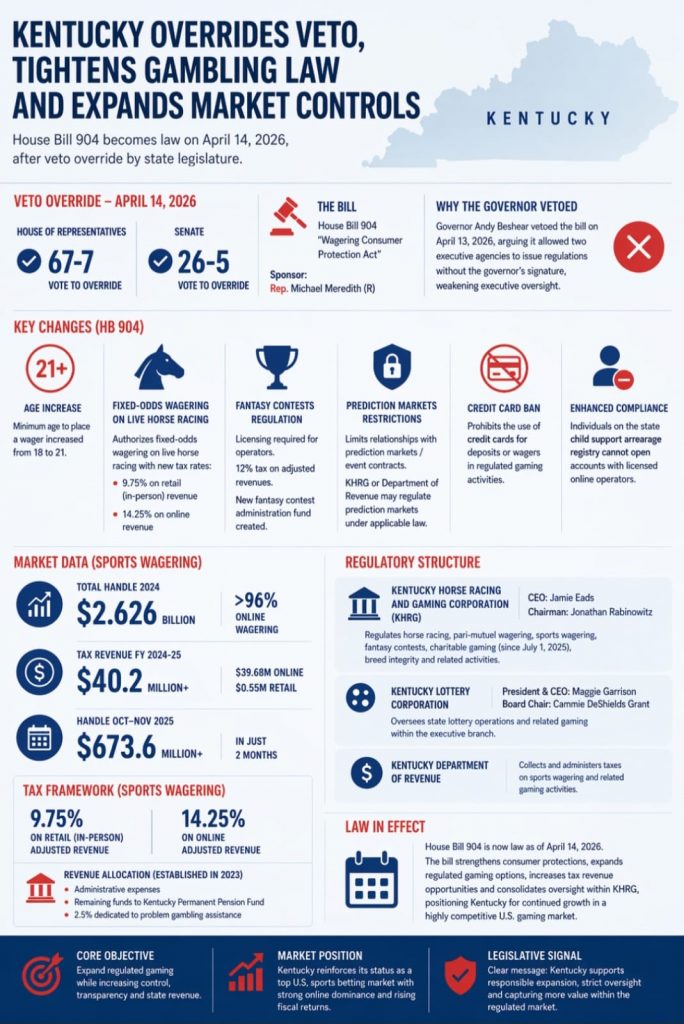
The move comes as Kentucky’s market continues to scale rapidly. The state recorded $2.626 billion in total handle in 2024, with more than 96% generated online, and produced over $40 million in tax revenue in the latest fiscal year. Momentum remains strong, with $673 million in handle recorded in just two months of late 2025, underscoring sustained growth.
HB 904 also consolidates regulatory authority within KHRG, which assumed oversight of charitable gaming in 2025, and strengthens compliance mechanisms, including restrictions on account access for individuals flagged in state financial obligation databases.
The override signals a clear legislative direction: Kentucky is not slowing gambling expansion, but recalibrating it with stricter consumer protections, broader taxable verticals and tighter control over emerging betting formats, positioning itself to capture more regulated revenue in a rapidly evolving U.S. gaming landscape.