















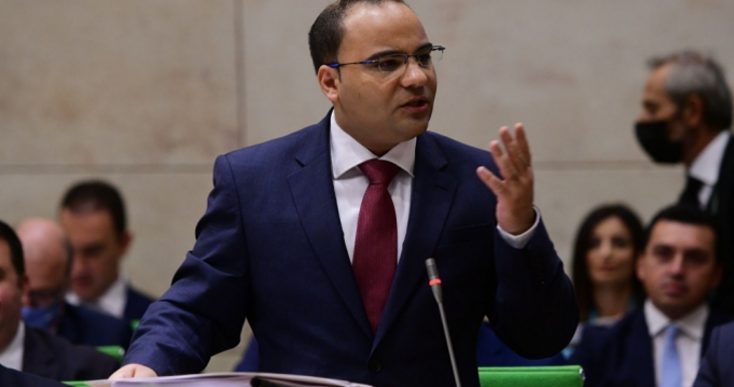
Malta has overhauled its gambling tax framework with the publication of Legal Notices 84 and 86 of 2026, a reform set to take effect on October 1, 2026, reshaping both VAT treatment and gaming tax under the Gaming Act (Cap. 583) and the Value Added Tax Act (Cap. 406). The move, driven by the Malta Tax and Customs Administration (MTCA) and the Malta Gaming Authority (MGA), aligns with the government’s Budget 2026, led by Finance Minister Clyde Caruana.

At its core, the reform introduces a structural shift. Legal Notice 84 of 2026 amends the Gaming Tax Regulations (S.L. 583.10), simplifying the tax model, merging the gaming tax with the gaming devices levy, and reinforcing a “place of consumption” principle, taxing activity where it occurs. Meanwhile, Legal Notice 86 of 2026 revises the VAT exemption under Item 9 of the Fifth Schedule, narrowing its scope to minister-approved gambling activities and removing longstanding ambiguities.
The economic impact is immediate. By tightening VAT exemptions, operators gain clearer access to input VAT recovery on eligible costs—technology, infrastructure, marketing—improving margins in a high-compliance environment.
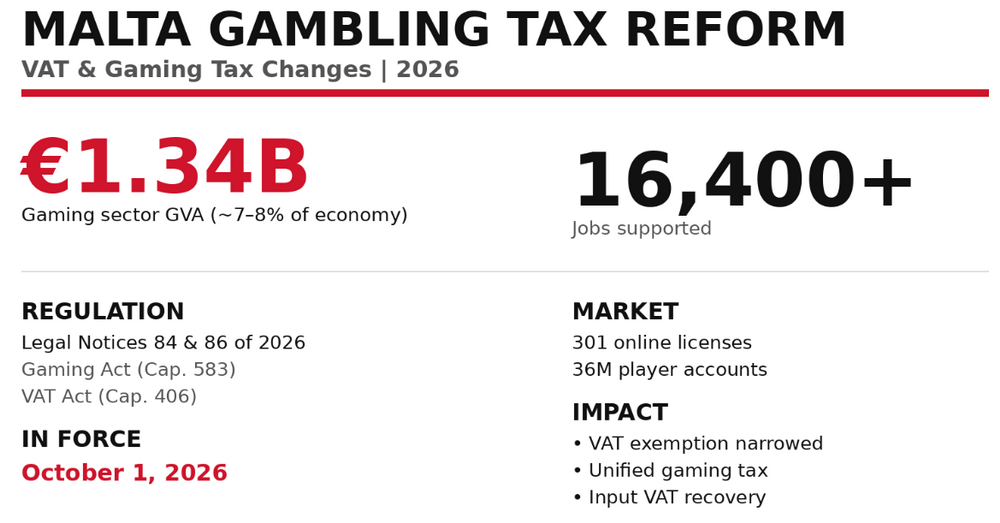
The reform comes as Malta doubles down on a sector that accounts for approximately 7%–8% of national GVA, generating around €1.34 billion and supporting over 16,400 jobs. As of mid-2025, the jurisdiction hosted 301 active online licenses and over 36 million player accounts across MGA-licensed platforms.
Backed by Economy Minister Silvio Schembri and MGA CEO Charles Mizzi, the strategy aims to reinforce Malta’s regulatory credibility amid rising global scrutiny on taxation, compliance, and integrity. The signal is clear: Malta is not retreating from iGaming—it is recalibrating it. For well-structured operators, the reform unlocks efficiency. For others, it raises the compliance bar.