













Connecticut again surpassed $2 billion in monthly wagers across iGaming and sports betting, while Washington, D.C. (the U.S. federal district, not Washington state) closed August 2026 with virtually flat handle and a 16.8% decline in revenue, highlighting two sharply different regulatory and digital-market models in the northeastern United States.

Washington, D.C. processed $53.82 million in sports wagers during August, down roughly 0.5% year over year from about $54.12 million in August 2025. GGR fell to $4.92 million, with a 9.14% hold, while tax revenue declined 14.4% to approximately $1.18 million.
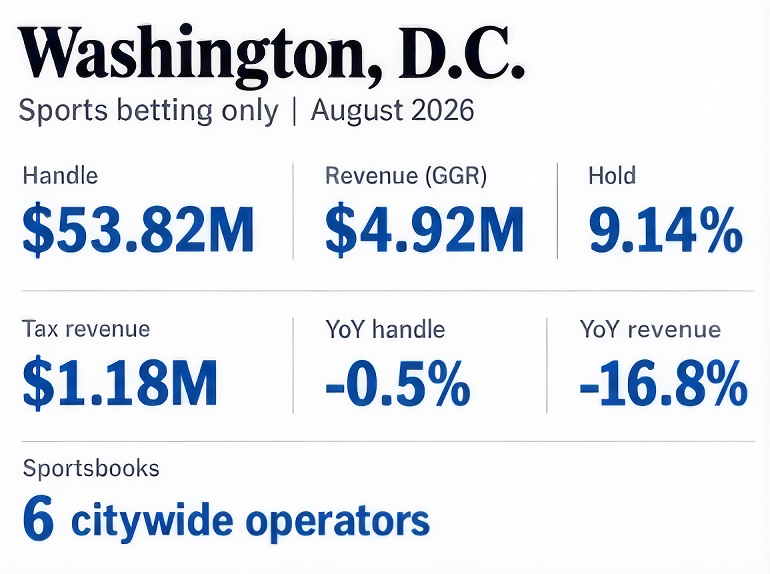
The Office of Lottery and Gaming (OLG), part of the Office of the Chief Financial Officer of the District of Columbia, regulates a market with six citywide sportsbooks: FanDuel, DraftKings, BetMGM, Caesars, Fanatics and theScore Bet. Broader competition followed the Sports Wagering Amendment Act of 2024. Thomas R. Burnside serves as OLG Executive Director; Eugene Vlasenko is Chief Operating Officer, Ridgley Bennett is Chief Counsel and Peter Alvarado is Director of Regulation and Oversight. Glen Lee is Chief Financial Officer of the District of Columbia.
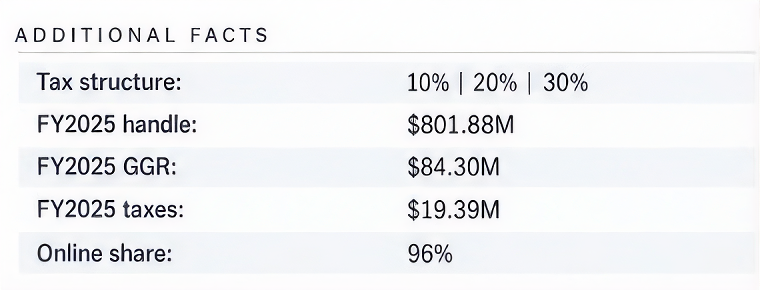
Washington, D.C. applies differentiated tax rates; 10% for certain Class B operators, 20% for Class A sportsbooks associated with major venues and 30% for certain Class C/mobile-only licenses. In July, FanDuel led the District market with approximately $24.5 million in handle, followed by DraftKings, BetMGM, Caesars and Fanatics.
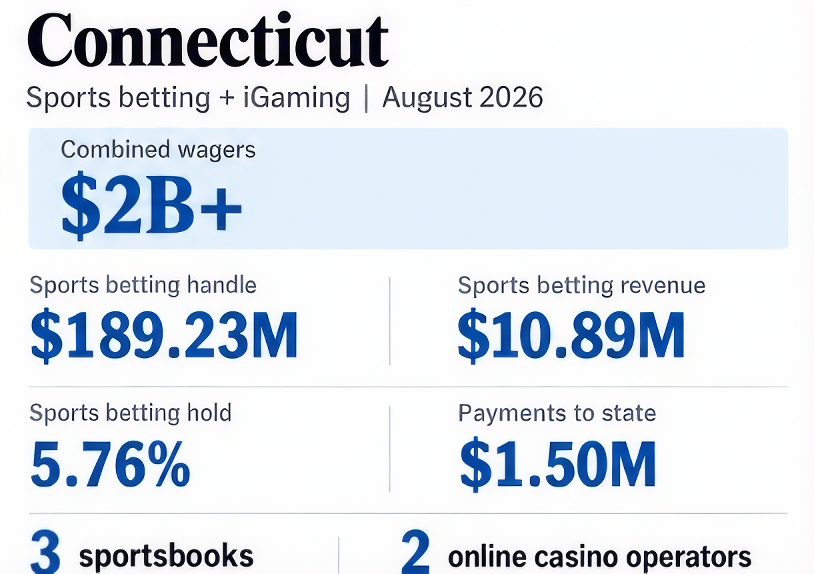
Connecticut operates on a different scale. In August, sports betting generated approximately $189.23 million in handle, $10.89 million in revenue, a 5.76% hold and $1.50 million in payments to the state. One month earlier, Connecticut had already recorded $2.05 billion in combined wagers, including $1.87 billion from iGaming and $181.3 million from sports betting.
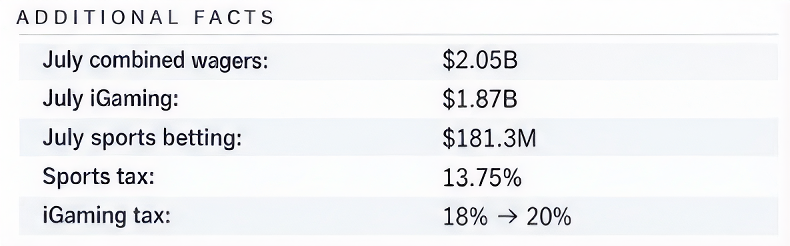
The market is concentrated among DraftKings/Foxwoods, FanDuel/Mohegan and Fanatics/Connecticut Lottery for sports betting, while only DraftKings and FanDuel are authorized to operate online casino gaming. Public Act 21-23, derived from House Bill 6451, imposes a 13.75% tax on sports betting GGR and taxes iGaming at 18% during the first five years, rising to 20% from the sixth year of operations.

Oversight falls to the Connecticut Department of Consumer Protection, led by Commissioner Bryan T. Cafferelli. On September 10, 2026, the state issued nine cease-and-desist orders and nearly 30 subpoenas targeting activities linked to prediction markets, reinforcing enforcement around the licensed market, minimum-age rules, self-exclusion and consumer protection.