








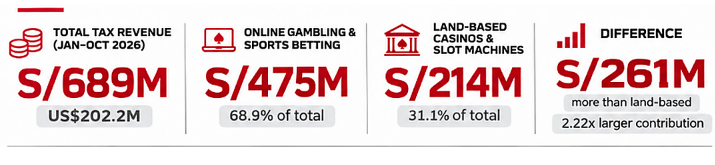
Lima, November 15, 2026. Peru’s gambling industry generated S/689 million (US$202.2 million) in tax revenue between January and October 2026, according to a report from the General Directorate of Casino Games and Slot Machines (DGJCMT), under the Ministry of Foreign Trade and Tourism (MINCETUR), updated through October 31. Online gambling and sports betting contributed S/475 million (68.9%), compared with S/214 million (31.1%) from casinos and slot machines. The figures exclude the Selective Consumption Tax (ISC).

The digital segment generated S/261 million more in tax revenue than land-based gambling, equivalent to 2.22 times its contribution. Peru has 46 licensed online gaming platforms and 49 authorized sports betting platforms, regulated under Laws 31557 and 31806 and Supreme Decree 005-2023-MINCETUR. Land-based establishments operate under Law 27153, as amended.
The regulated market comprises 4,477 sports betting outlets, 659 slot machine venues, and 15 casinos, alongside 69,433 gaming machines interconnected with MINCETUR and the National Superintendency of Customs and Tax Administration (SUNAT).
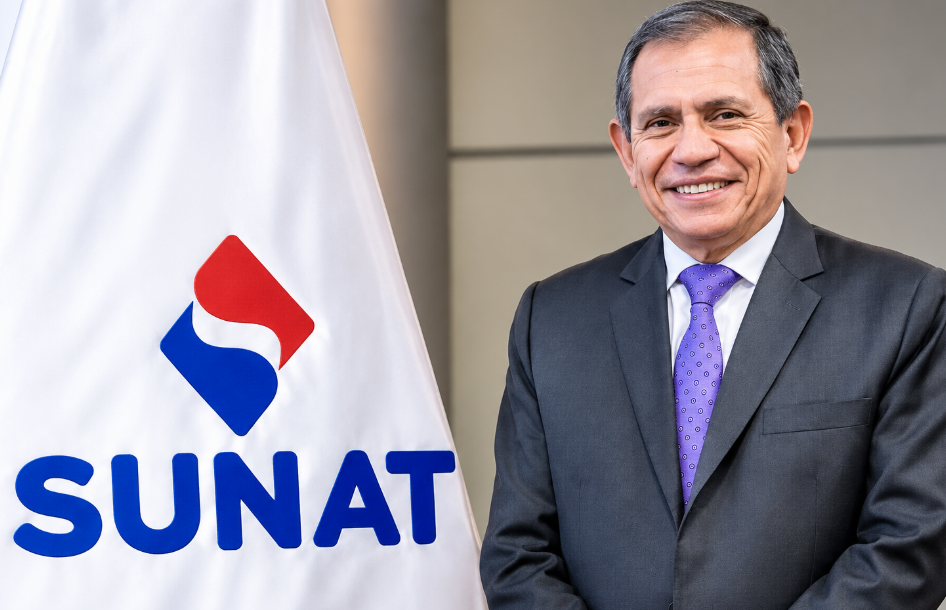
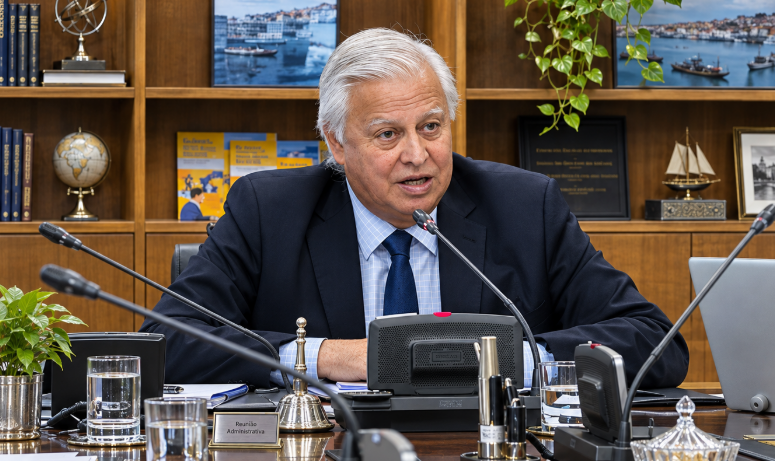
César Alfonso Luna Victoria León
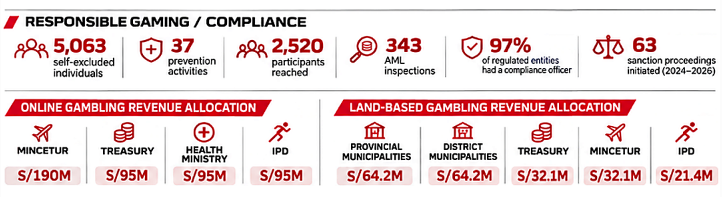
Of land-based tax revenue, S/64.2 million is allocated to provincial municipalities, another S/64.2 million to district municipalities, S/32.1 million to the Public Treasury, S/32.1 million to MINCETUR, and S/21.4 million to the Peruvian Sports Institute (IPD). The statutory allocation of online gambling revenue provides S/190 million for MINCETUR and S/95 million each for the Treasury, Ministry of Health, and IPD.
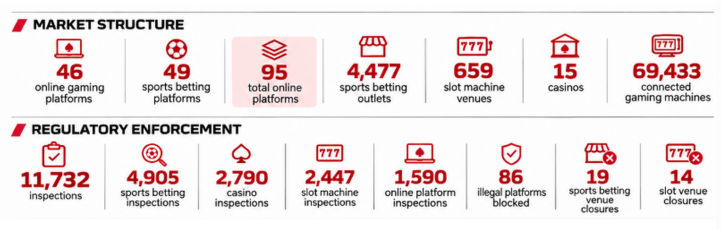
The DGJCMT conducted 11,732 inspections: 4,905 at sports betting outlets, 2,790 at casinos, 2,447 at slot machine venues, and 1,590 involving online platforms. It also recorded 86 digital platform blocks, 19 sports betting venue closures, and 14 slot machine venue closures.
Minister Rogers Martín Valencia Espinoza, Vice Minister Nancy Aracelly Laca Ramos, and Director Yuri Guerra Padilla lead sector oversight, while César Alfonso Luna Victoria León heads SUNAT, the authority responsible for tax administration.

The self-exclusion register contains 5,063 individuals. During 2026, authorities conducted 37 prevention activities involving 2,520 participants, alongside 343 anti-money laundering inspections. Some 97% of regulated entities had appointed a compliance officer, while 63 sanction proceedings were initiated between 2024 and 2026.