















South Korea and Japan have escalated enforcement against illegal betting in 2025–2026, deploying aggressive regulatory frameworks that combine criminal sanctions, market control and targeted disruption of digital acquisition channels, in a shift that is already reshaping the scale of illicit gambling activity across Asia.

In South Korea, the Korea Sports Promotion Foundation (KSPO) —under the Ministry of Culture, Sports and Tourism— has intensified its crackdown through a whistleblower reward system offering up to KRW 200 million (≈US$145,000) for reporting illegal sports betting operations. Managed through the Illegal Sports Toto Reporting Center, the program targets not only operators but also users, promoters and platform developers.

Under the National Sports Promotion Act, sports betting is only permitted through the state-controlled Sports Toto system. Any parallel activity is prosecuted under the Criminal Act (Articles 246–247) and the Speculative Acts Regulation Act, with penalties reaching up to seven years in prison or fines of KRW 70 million for operators, and five years or KRW 50 million for users.
The scale of the illegal market justifies the escalation, official monitoring data shows that in 2024 authorities identified an illicit betting volume of approximately KRW 3.9 trillion, with over 59,000 illegal sites reviewed, more than 26,000 access blocks enforced, and 311 individuals arrested or charged.
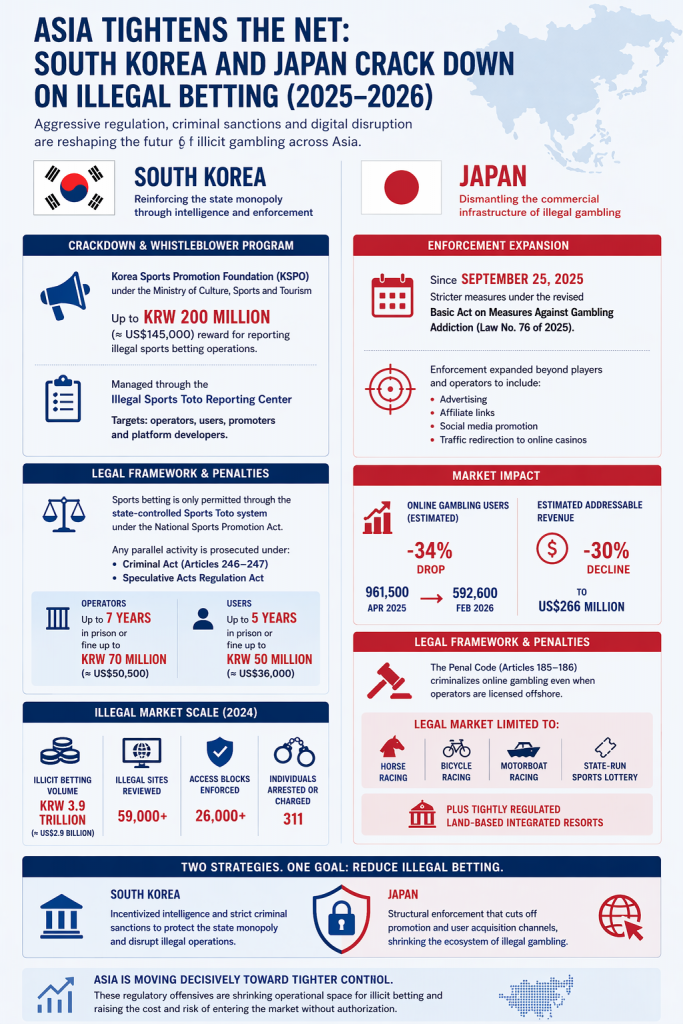
Japan has taken a broader structural approach under the National Police Agency (NPA), led in 2026 by Commissioner General Yasuhiro Tsuyuki. Since September 25, 2025, authorities have enforced stricter measures under the revised Basic Act on Measures Against Gambling Addiction (Law No. 76 of 2025), expanding enforcement beyond players and operators to include advertising, affiliate links, social media promotion and traffic redirection to online casinos.

Japan’s sector data shows a 34% drop in online gambling activity, falling from 961,500 to 592,600 estimated users between April 2025 and February 2026, while estimated addressable revenue declined 30% to US$266 million.
The Penal Code (Articles 185–186) criminalizes online gambling even when operators are licensed offshore, while the legal market is limited to public betting verticals such as horse racing, bicycle racing, motorboat racing and the state-run sports lottery, alongside tightly regulated land-based Integrated Resorts.
Asia is moving decisively toward tighter control. South Korea is reinforcing its state monopoly through incentivized intelligence, while Japan is dismantling the commercial infrastructure of illegal gambling by cutting off promotion and user acquisition channels. Together, these strategies are shrinking the operational space for illicit betting and redefining the regulatory cost of entering the market without authorization.