










South Korea’s casino sector showed a sharp correction in March 2026, with revenue declines of up to -39.6% year-on-year, despite rising betting activity. Data from Grand Korea Leisure (GKL), led by Young-San Kim, and Paradise Co, led by Lim Jun-shin, highlights a growing disconnect between volume and profitability in a market valued at approximately US$2.3 billion annually.

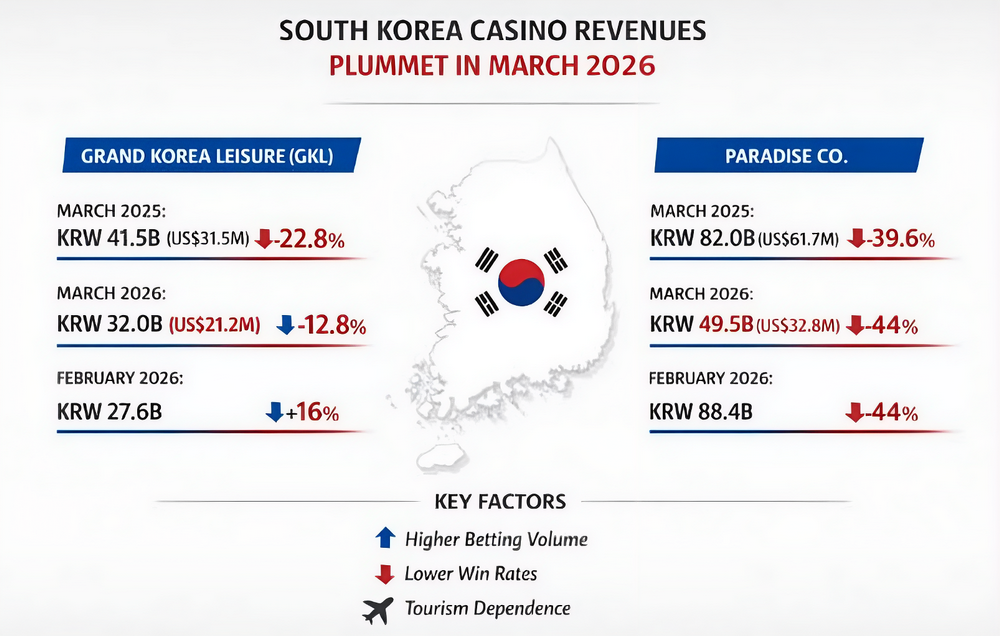
In March 2026, GKL reported casino revenue of KRW 32.0 billion (US$21.2M), down from around KRW 41.5 billion in March 2025 (-22.8% YoY). However, total betting volume (“drop”) increased +13.5% YoY to KRW 339.3 billion, indicating stronger player activity. On a monthly basis, revenue rose +16% versus February 2026, suggesting partial recovery after a weaker start to the year.

The decline was more severe at Paradise Co, which posted KRW 49.5 billion (US$32.8M) in March 2026, compared to roughly KRW 82.0 billion in March 2025 (-39.6% YoY) and -44% month-on-month. Despite this, table drop increased +9.7% versus February, reaching KRW 587.7 billion, while Q1 2026 revenue remained slightly positive (+1.8% YoY).

The data points to a clear microeconomic pressure: more players, but lower monetization per table, particularly within VIP segments where win rates declined. At a macro level, South Korea’s casino model—restricted to foreign players under the Tourism Promotion Act—amplifies volatility, as revenues depend heavily on international tourism flows and spending patterns.
No major new fiscal regulations were introduced in April 2026, although a recent sector-wide agreement led by the Ministry of Culture, Sports and Tourism has increased operational oversight. Meanwhile, inflation pressures (CPI 118.8 in March) and rising regional competition are weighing on discretionary spending.
The contrast is structural: the industry grew +18.3% in 2025, yet March 2026 exposes its fragility. South Korea now faces a strategic decision—maintain its restrictive model or introduce reforms to stabilize revenues in an increasingly competitive Asian gaming landscape.