











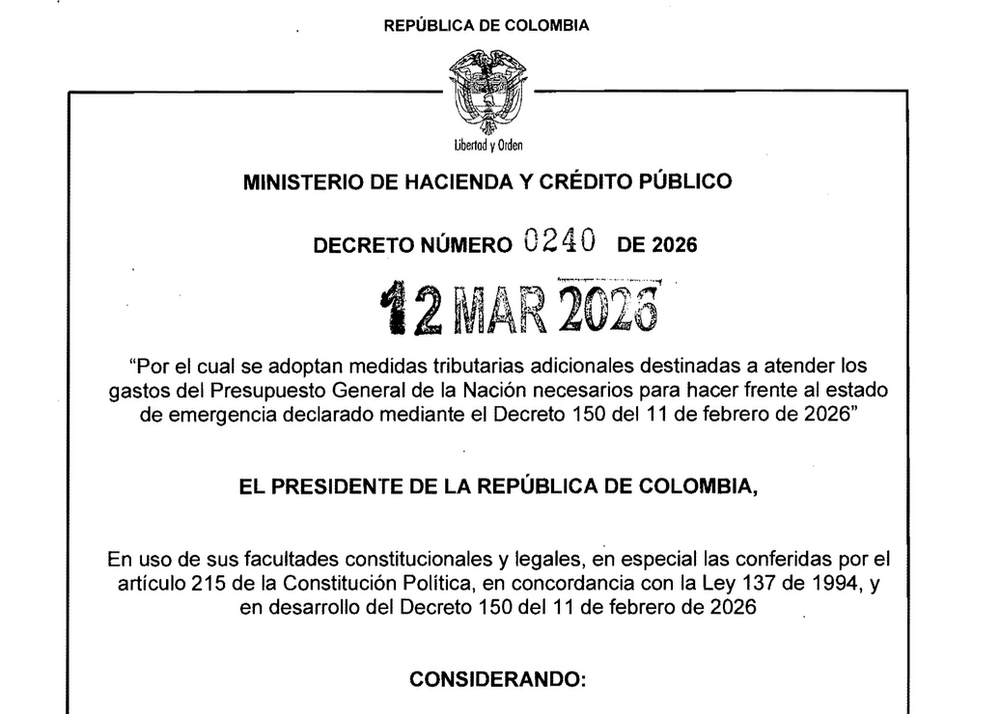
Colombia’s regulated online gaming sector woke up to a new tax burden, though no longer under the 19% VAT scheme that had been provisionally suspended by the Constitutional Court in early February. This time, the government issued Decree 0240 of March 12, 2026, a new emergency measure creating a 16% national consumption tax for games of chance operated exclusively online.
The change is significant. The decree states that the taxable event will be the money deposit made by each bettor to an authorized operator in order to fund their user account and gain the right to place bets. This includes cash payments, bank transfers and cryptoassets. At the same time, the regulation establishes that the taxable base will be the gross gaming revenue (GGR), understood as total wagers minus prizes paid out during the corresponding two-month period. That combination makes the new scheme structurally different from the government’s earlier attempt and opens a new phase of fiscal pressure for licensed operators.

The political and legal backdrop is key. As Mundo Video® had already reported, Colombia’s Constitutional Court provisionally suspended Legislative Decree 1390 of 2025, which sought to impose a 19% VAT on online gaming, while constitutional review remains pending. A later article also recalled that the Attorney General’s Office had asked for that tax to remain in force, arguing that it met standards of necessity and proportionality. Now the government is responding with a different tax architecture and argues in Decree 0240 itself that the earlier suspension did not amount to res judicata or a final ruling of unconstitutionality. In its view, that left room to adopt new emergency tax measures under a new factual context tied to Decree 150 of February 11, 2026.
The administration justifies the measure by arguing that online gambling shows strong contributive capacity, sustained GGR growth and a preferential tax treatment compared to land-based gaming. It also claims demand for the service is relatively inelastic and that the new tax does not affect essential goods or generate direct inflationary pressure. In other words, the government is presenting the sector as a viable source of immediate revenue in the middle of an economic, social and ecological emergency.
But the decree goes beyond the rate itself. It also tightens pressure on the wider operating chain: tech platforms, payment gateways, software providers, media outlets and other third parties must refrain from serving unauthorized operators or risk sanctions. That sends a clear signal. The new pressure does not fall only on bettors or concessionaires, but on the entire ecosystem surrounding both legal and illegal online gaming.
For the industry, the message is direct: fiscal risk remains alive, only under a different name. A market that, just weeks ago, was debating whether the 19% VAT would survive constitutional review must now absorb a 16% consumption tax introduced through a new emergency route.