

















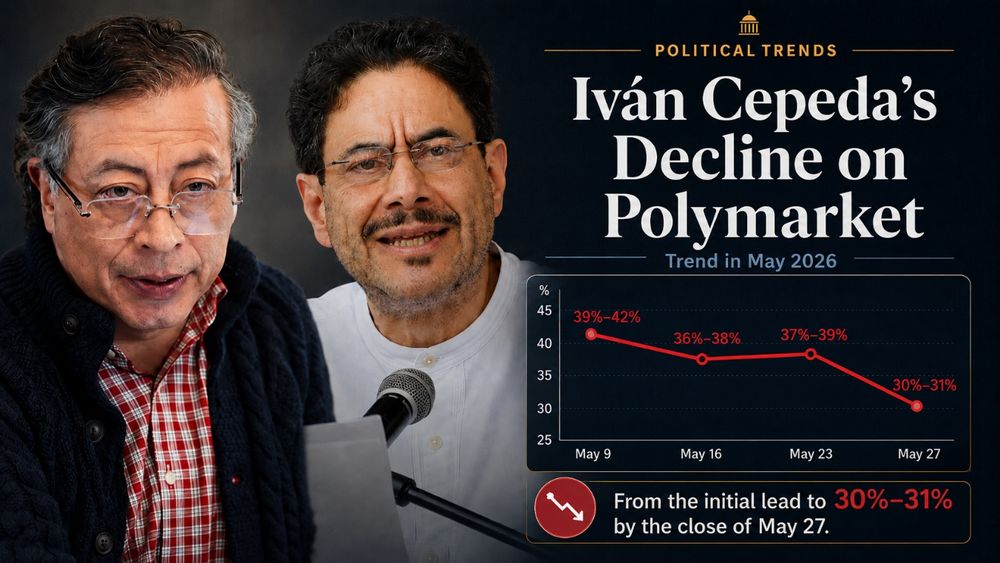
With just four days remaining before Colombia’s presidential first round, crypto prediction platform Polymarket has transformed the Colombian election into one of Latin America’s most heavily traded political events of May 2026. The central story is that the market experienced a dramatic reversal in sentiment throughout the month: Iván Cepeda, identified internationally with Colombia’s left-wing establishment and former guerrilla-linked political sector, began May as the clear betting favorite, but by the end of the month Abelardo de la Espriella had emerged as the dominant market choice to take control of the Casa de Nariño, while Paloma Valencia steadily lost strength within the conservative vote.

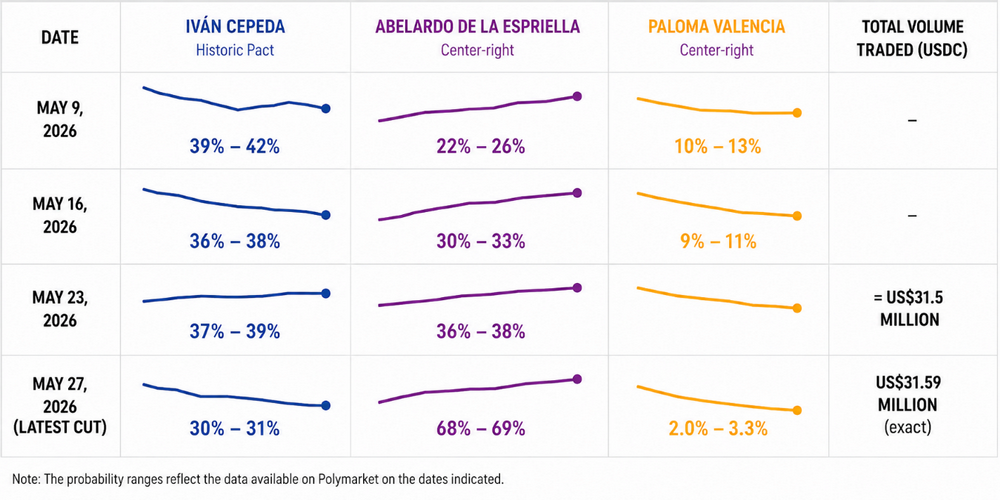
Weekly market snapshots show how rapidly investor sentiment shifted during May. On 9 May, Polymarket showed Cepeda leading with probabilities ranging between 39% and 42%, while De la Espriella traded between 22% and 26% and Paloma Valencia hovered around 10% to 13%.

Abelardo De La Espriella
By 16 May, the market had already begun pricing in a sharp anti-government momentum shift. Cepeda dropped toward a range of 36% to 38%, while De la Espriella surged to approximately 30%-33% and Valencia weakened further to between 9% and 11%.
The major turning point arrived on 23 May, when Polymarket entered what traders described as a virtual dead heat. Cepeda traded between 37% and 39%, while De la Espriella climbed to roughly 36%-38%, effectively erasing the left’s advantage. During the same period, an AtlasIntel poll for Revista SEMANA showed Cepeda at 38.7% and De la Espriella at 37.3%, reinforcing the tightening race reflected in prediction markets.

Paloma Valencia
By the official close on 27 May, the betting landscape had shifted decisively. The Polymarket presidential dashboard showed Abelardo de la Espriella leading with a powerful 68%-69% probability of becoming Colombia’s next president, while Cepeda collapsed to approximately 30%-31% and Paloma Valencia plunged to between 2.0% and 3.3%. Total trading volume in the market reached exactly US$31.59 million, making Colombia one of Polymarket’ s most active emerging political markets of 2026.
Polymarket operates through binary prediction contracts built on the Polygon blockchain and settled in the stable coin USDC. Each candidate shares functions as a contract; if the candidate wins the presidency, the contract settles at exactly US$1.00, while losing positions expire worthless.

The Colombian case mirrors what occurred during the Portugal 2026 presidential election, where Polymarket handled millions of dollars in political contracts and ultimately aligned closely with the official electoral outcome. Colombia now illustrates how prediction markets are increasingly functioning as a parallel geopolitical indicator for global traders, media organizations and financial operators attempting to anticipate political shifts in real time.